Tampilkan postingan dengan label Brigham Young University. Tampilkan semua postingan

Minggu, 15 Oktober 2017

Wow , Origami Inspires Tiny Medical Devices

Origami Inspires Tiny Medical Devices

Tiny origami-inspired devices are opening up new possibilities for minimally invasive surgery
Some of the BYU technology recently licensed to Intuitive Surgical, leader in robotic surgery

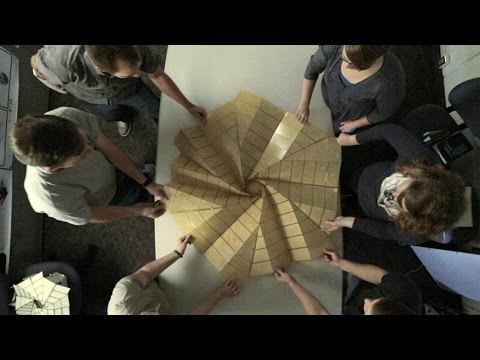
BYU mechanical engineering professors have made a name for themselves by applying the principles of origami to engineering. Now they’re applying their origami skills to a new realm: the human body. Mechanical engineering professors Spencer Magleby, Larry Howell, Brian Jensen and a team of students are working toward surgical technology that will allow for the manufacturing of instruments so small that the size of incisions necessary to accommodate the tools can heal on their own—without sutures.

“The whole concept is to make smaller and smaller incisions,” Howell said. “To that end, we’re creating devices that can be inserted into a tiny incision and then deployed inside the body to carry out a specific surgical function.”

As a part of their work, BYU just licensed a series of compliant mechanism technologies to Intuitive Surgical, the world leader in robotic surgery and the maker of the popular da Vinci Surgical System. The deal is the latest in a number of collaborations with Intuitive Surgical, which connected with BYU on advice from the White House Office of Science and Technology Policy.

The researchers say their work is inspired by a need for increasingly smaller surgical tools; the industry has reached the limit to where they can’t go any smaller with traditional designs. BYU’s team has engineered new design concepts that eliminate the need for pin joints and other parts, instead relying on the deflection inherent in origami to create motion.

“These small instruments will allow for a whole new range of surgeries to be performed—hopefully one day manipulating things as small as nerves,” Magleby said. “The origami-inspired ideas really help us to see how to make things smaller and smaller and to make them simpler and simpler.”

One such instrument is a robotically-controlled forceps so small it can pass through a hole about 3 millimeters in size—roughly the thickness of two pennies held together.

Outside their work with Intuitive Surgical, BYU’s team is developing concepts such as the D-Core, a device that starts out flat (to be inserted into an incision) then expands to become two rounded surfaces that roll on each other, mimicking the movement made by spinal discs.

Magleby says the work they are doing on medical devices is not much different in principle than the work they’ve done for NASA to create compact space equipment.

“Those who design spacecraft want their products to be small and compact because space is at a premium on a spacecraft, but once you get in space, they want those same products to be large, such as solar arrays or antennas,” Magleby said. “There’s a similar idea here: We’d like something to get quite small to go through the incision, but once it’s inside, we’d like it to get much larger.”

BYU’s latest research on origami-inspired engineering appears in the February issue of academic journal Mechanism and Machine Theory.

Video Terkait Video Origami Inspires Tiny Medical Devices

  • Origami: Basket
    Origami: Basket
    In this video I bring you here for an origami easy, a basket that can be used for various decorations
    Learn in this tutorial how to make a paper basket using only ...

  • Origami Crab - Origami Easy
    Origami Crab - Origami Easy
    Watch how to make an origami crab in step by step
    This origami is very easy to fold
    My paper: 10 x 10 cm This origami was designed by Fumiaki Shingu ♥ Also ...

  • Origami for Kids - Origami Rabbit - Origami Animals
    Origami for Kids - Origami Rabbit - Origami Animals
    This quick tutorial shows how to make a quick and cute origami rabbit
    It's so easy that you could do this successfully with kids ♥ Also check out some of my ...

  • Origami: Heart Box & Envelope
    Origami: Heart Box & Envelope
    Heart envelope that opens like a box! Learn in this video how to make an origami special for Valentine's Day

    Download this video here: ...

Kamis, 05 Oktober 2017

Wow , Bullet-proof origami: folding Kevlar shield designed by BYU mechanical engineers

Bullet-proof origami: folding Kevlar shield designed by BYU mechanical engineers

BYU mechanical engineers have created an origami-inspired, lightweight bulletproof shield that can protect law enforcement from gunfire. The new ballistic barrier can be folded compactly when not in use, making it easier to transport and deploy. When expanded — which takes only five seconds — it can provide cover for officers and stop bullets from several types of handguns.

“We worked with a federal special agent to understand what their needs were, as well as SWAT teams, police officers and law enforcement, and found that the current solutions are often too heavy and not as portable as they would like,” said Larry Howell, professor of mechanical engineering at BYU. “We wanted to create something that was compact, portable, lightweight and worked really well to protect them.”

In working with law enforcement, BYU researchers learned much of what is currently used hasn’t evolved much from medieval times: shields that are mostly flat, awkward plates that cover only one person. Current barriers are so heavy and cumbersome they make it difficult for officers to move into position.

The barrier Howell and his colleagues designed is made of 12 layers of bulletproof Kevlar and weighs only 55 pounds (many of the steel-based barriers in current use approach 100 pounds). The BYU-built barrier uses a Yoshimura origami crease pattern to expand around an officer, providing protection on the side in addition to protecting them in the front.

In testing, the barrier successfully stopped bullets from 9 mm, .357 Magnum and .44 Magnum pistols.

“Those are significant handguns with power,” Howell said. “We suspected that something as large as a .44 Magnum would actually tip it over, but that didn’t happen. The barrier is very stable, even with large bullets hitting it.”

The researchers constructed the barrier prototypes to be extremely stiff and protective throughout, while also maintaining the flexible qualities of Kevlar fabric so they can be folded compactly. Since Kevlar fabric is subject to fraying, abrasion and is sensitive to sunlight and water, the team also made a concentrated effort to reinforce it against the environment.

“It goes from a very compact state that you can carry around in the trunk of a car to something you can take with you, open up and take cover behind to be safe from bullets,” said Terri Bateman, BYU adjunct professor of engineering and research team member. “Then you can easily fold it up and move it if you need to advance your position.”

In addition to protecting police officers, researchers believe the barrier could be used to protect children in a school or a wounded person in an emergency situation. Although the ballistic barrier is now just in prototype form and not currently in use by any law enforcement agencies, Howell and Bateman have tested it with officers on site. The response has been positive so far.

“There are a lot of risks to law personnel and we feel like this particular product can really make a difference and save a lot of lives,” Bateman said. “It makes us feel like we’re really making a difference in the world.”

Video Terkait Video Bullet-proof origami: folding Kevlar shield designed by BYU mechanical engineers

  • Bullet-proof origami: folding Kevlar shield designed by BYU mechanical engineers
    Bullet-proof origami: folding Kevlar shield designed by BYU mechanical engineers
    BYU mechanical engineers have created an origami-inspired, lightweight bulletproof shield that can protect law enforcement from gunfire
    The new ballistic ...

  • Tran Nga 3D Origami
    Tran Nga 3D Origami
    Hi everyone! Welcome to Tran Nga 3D Origami channel
    I am Nga , a handcraftsman about 3d origami in Vietnam
    My channel will show you about 3d origami ...

  • calista origami
    calista origami
    Tutorial aneka origami, seperti cara membuat pesawat kertas, cara membuat perahu kertas, dan aneka origami lainnya yang unik dan menarik
    Jangan lupa ...

  • Origami Fidget Spinner
    Origami Fidget Spinner
    [Rather Simple] How to fold an Origami Fidget Spinner that can spin endlessly, because YOU spin it! And It can spin in three different ways and it can even fly ...

Wow , Science of Innovation: Origami Structures

Origami is the ancient Japanese art of paper folding. But to engineer Mary Frecker of Pennsylvania State University, it is the future for de...